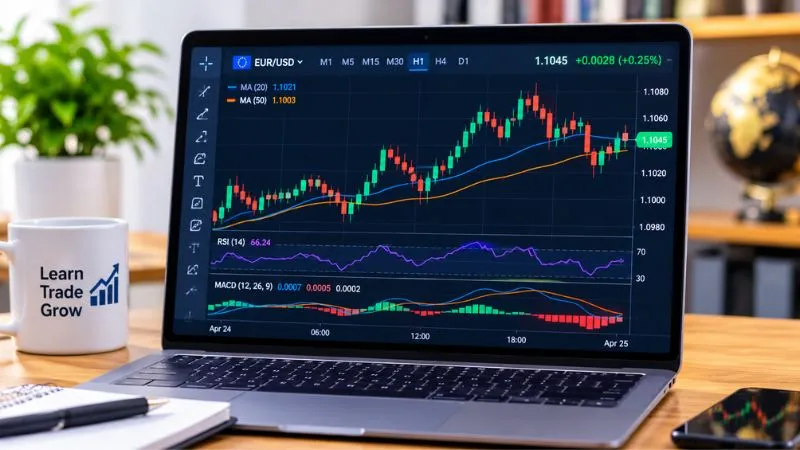
Financial markets have become an important subject for people interested in understanding currencies, company shares and international economic activity. Before participating in these markets, it is important to learn how trading works, how prices move and what risks are involved.
This beginner's guide introduces the basic concepts of forex trading and the stock market. Whether you are researching a trading course, exploring trading courses online or looking for a structured way to learn trading, the first step is to understand the market rather than focusing on quick profits.
- What forex trading means and how currency pairs work
- How forex trading differs from stock market trading
- Basic trading terms such as pips, spreads and leverage
- How to understand candlestick charts
- Why technical and fundamental analysis matter
- Why risk management is essential for every trader
1. What Is Forex Trading?
Forex stands for foreign exchange. Forex trading involves exchanging one currency against another through a currency pair. For example, EUR/USD represents the euro against the US dollar. A currency pair shows how much of the quote currency is needed to purchase one unit of the base currency.
Currency prices can change in response to economic announcements, interest-rate decisions, inflation, employment data, international trade and geopolitical developments. Traders study these factors to understand possible price movements.
A person interested in a forex trading course should first understand the purpose of currency pairs, how exchange rates are quoted and why prices fluctuate. These basic concepts provide a foundation for further study of trading platforms and market analysis.
What Are Currency Pairs?
In forex, currencies are commonly displayed in pairs. The first currency is called the base currency and the second is the quote currency.
| Currency Pair | Common Name | What It Represents |
|---|---|---|
| EUR/USD | Euro / US Dollar | Euro value against the US dollar |
| GBP/USD | Pound / US Dollar | British pound value against the US dollar |
| USD/JPY | US Dollar / Japanese Yen | US dollar value against the Japanese yen |
| USD/CHF | US Dollar / Swiss Franc | US dollar value against the Swiss franc |
2. What Is the Stock Market?
The stock market is a marketplace where shares of publicly listed companies are bought and sold. A share represents ownership in a company. Investors and traders study company performance, financial statements, industry conditions and broader economic developments when evaluating shares.
Stock market learning involves understanding shares, stock exchanges, market orders, price charts, company fundamentals and investment risks. It is related to forex education, but the instruments and market characteristics are not the same.
People searching for a forex stock market course in Rawalpindi should check whether a programme explains both currency markets and stock market fundamentals, and whether the course clearly separates the different instruments and risks.
3. Forex Trading vs Stock Market Trading
Forex and stock markets both involve financial instruments and changing prices, but they operate differently. Understanding their differences helps beginners decide which concepts they need to study.
| Feature | Forex Market | Stock Market |
|---|---|---|
| What is traded? | Currency pairs | Company shares and other listed securities |
| Price factors | Interest rates, currencies and economic data | Company results, valuation and market conditions |
| Key terminology | Pips, spreads, lots and currency pairs | Shares, dividends, indices and market orders |
| Analysis | Technical and fundamental analysis | Technical and company fundamental analysis |
| Important risks | Currency volatility and leverage | Price volatility and company-specific risk |
Neither market is automatically suitable for every person. The choice depends on financial knowledge, objectives, risk tolerance and understanding of the instruments involved.
4. Important Forex Trading Terms Beginners Should Know
Before starting practical trading lessons, beginners should become familiar with common forex terminology. These terms are used when reading market prices, understanding transaction costs and studying trade examples.
Pip
A pip is a standard unit used to describe changes in the price of many currency pairs. The exact decimal convention can vary by instrument and quotation.
Spread
The spread is the difference between the bid price and ask price quoted for a financial instrument.
Leverage
Leverage allows exposure to a position larger than the funds deposited. It can increase both potential gains and losses.
Lot Size
Lot size describes the quantity of currency units in a forex transaction. Position size affects the amount at risk.
Stop Loss
A stop-loss instruction is used to close a position when a specified price level is reached. Execution can differ in fast or illiquid markets.
Take Profit
A take-profit instruction is intended to close a position when a selected target price is reached.
5. How to Read Forex Charts and Candlesticks
A trading chart displays the price movement of a financial instrument over a selected period. Charts help traders study historical price behaviour and identify patterns, trends and important price levels.
Candlestick charts are widely used in technical analysis. Each candle represents price activity during a particular time interval. A candle generally displays four important values:
- Open: The price at the beginning of the interval.
- High: The highest price reached during the interval.
- Low: The lowest price reached during the interval.
- Close: The price at the end of the interval.
Beginners should learn how to identify bullish and bearish candles, understand candle bodies and wicks, and observe how candles form across different timeframes. A candlestick pattern alone does not guarantee a future price movement.
6. Technical Analysis and Fundamental Analysis
Market analysis is an important part of a structured trading education. Two commonly discussed approaches are technical analysis and fundamental analysis.
Technical Analysis
Technical analysis studies price charts, historical movements, indicators and trading volume where available. Beginners may learn about support and resistance, trend lines, moving averages and other chart-based tools.
Fundamental Analysis
Fundamental analysis examines economic, financial and business information that may influence an instrument's value. In forex, this can include inflation, employment figures, central-bank decisions and economic growth. In stock markets, it can include company earnings, financial statements and industry developments.
Both approaches have limitations. Market information can be uncertain, and no analysis method can predict every price movement.
7. Why Risk Management Is Essential in Trading
Learning trading is not only about reading charts or identifying possible market directions. Risk management is equally important because financial markets can move unexpectedly and losses are possible.
A responsible learning process should explain how position size,leverage, stop-loss orders and risk-to-reward calculations work. Students shouldunderstand the possible loss on a trade before considering any market position.
- Understand the amount of money exposed to risk.
- Learn how leverage can magnify losses.
- Study how position size affects potential loss.
- Understand the limitations of stop-loss execution.
- Avoid making decisions based only on social media tips.
- Never assume that a previous result guarantees future performance.
8. How to Start Learning Trading as a Beginner
Beginners should follow a structured learning path rather than opening a live trading account without understanding the market. A good learning process begins with terminology and gradually moves towards chart interpretation and risk awareness.
Step 1: Understand the Financial Markets
Learn the difference between forex, stocks, commodities and other financial instruments. Understand what is being traded and how prices are quoted.
Step 2: Study Trading Terminology
Learn currency pairs, pips, spreads, lot sizes, margin, leverage, bid price and ask price.
Step 3: Learn Charts and Market Analysis
Study candlesticks, timeframes, trends, support, resistance and the basic concepts of technical and fundamental analysis.
Step 4: Understand Risk Management
Practise calculating position size and possible losses. Understand leverage and the limitations of risk-control orders.
Step 5: Practise in a Demo Environment
Where available, use a demo account to become familiar with platform functions and practise reading charts without risking real money. Demo performance does not guarantee live results.
9. How to Choose a Forex Trading Course
People searching for trading classes or trading courses online should compare course content rather than choosing a programme based only on promotional claims. A useful beginner course should explain the underlying concepts and provide a clear learning sequence.
Before selecting a trading course, consider these points:
- Does the course begin with basic financial-market concepts?
- Does it explain currency pairs and common forex terminology?
- Are charts and candlestick concepts included?
- Does it explain technical and fundamental analysis?
- Is risk management included in the course outline?
- Are practical demonstrations or guided exercises provided?
- Does the institute explain what the course does and does not cover?
A course should focus on education and practical understanding. Be cautious of anyone promising guaranteed profits, fixed returns or minimum risk trading results.
10. Forex Trading Course in Islamabad and Rawalpindi
Students interested in understanding financial markets can explore structured learning options before making decisions about live trading. If you are searching for a forex trading course in Islamabad or a forex trading course in Rawalpindi, review the course outline, learning format and practical topics covered.
Careervision Training Institute provides professional training programmes in Islamabad and Rawalpindi. Learners researching a forex stock market course in Rawalpindi
Careervision Training institue offered practicalForex Trading Course, Professional experts provide briefing of course specific information. Visit that page for the programme details rather than relying on this general beginner's guide.
Explore Forex Trading Learning at CareerVision
Interested in learning forex trading and understanding financial-market concepts? Explore the course details and contact CareerVision to ask about the current training schedule and learning options in Islamabad and Rawalpindi.
Forex Trading Course DetailsFrequently Asked Questions About Forex Trading
Conclusion: Build Your Trading Knowledge Step by Step
Learning forex and stock market concepts requires patience, structured study and an understanding of financial risk. Beginners should focus on currency pairs, market terminology, charts, analysis methods and risk management before considering live trading.
If you are exploring a trading course, comparing trading classes or researching a forex trading course in Rawalpindi and Islamabad, start by reviewing the course content and learning approach. You can find the programme details on the CareerVision Forex Trading Course page.